Working with the RarePlex® Developer Kit
How RareCyte’s assay-development lead builds custom circulating-tumor-cell assays by adding up to two of your own biomarkers to a validated RarePlex panel.
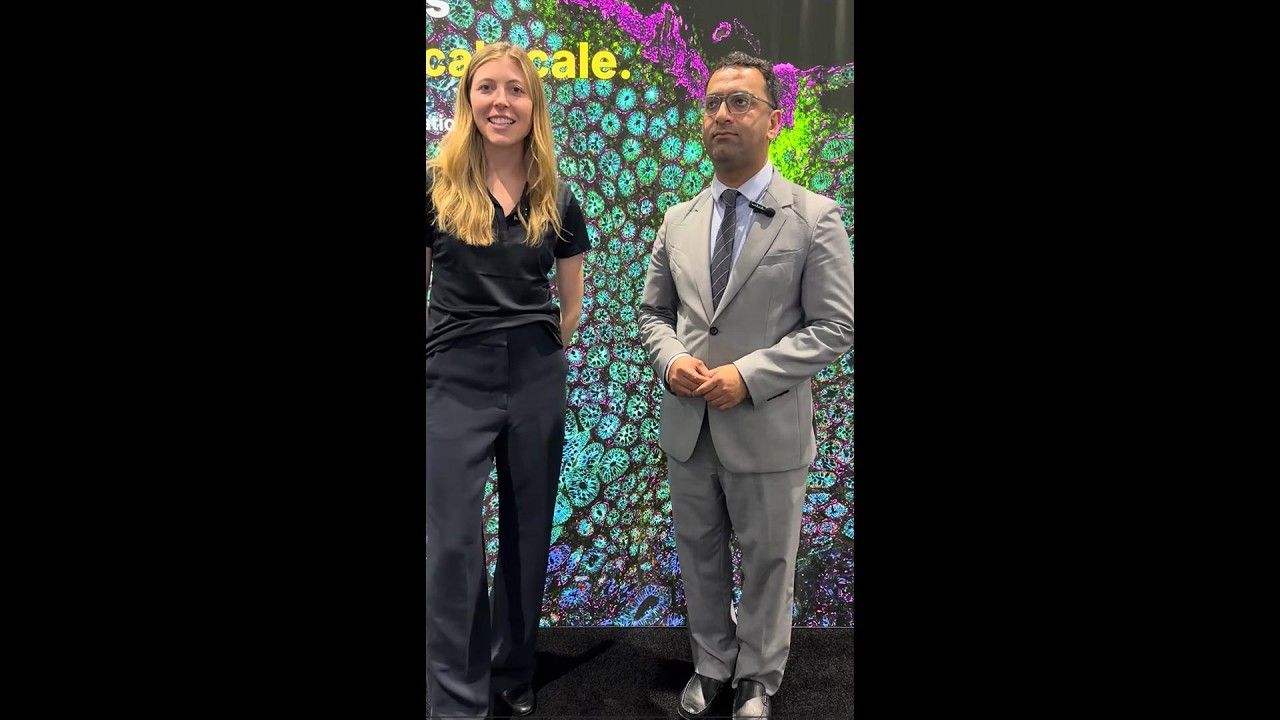
RareCyte’s Edward Lo, who leads assay development, walks through how the RarePlex Developer Kit lets a lab build its own circulating-tumor-cell (CTC) assay by adding up to two custom biomarkers to a validated RarePlex Enumeration or Biomarker Panel Kit. He starts from the gap the kit is built to close — few off-the-shelf assays exist for the fast-growing list of CTC markers researchers want to measure — then walks the development workflow end to end: establish control cell lines, screen antibody clones on model CTCs, and titrate the chosen clone to the best signal-to-background. Worked examples run from a single-marker EGFR stain on A549 cells to a two-marker Ki-67/EGFR stain and a clinical prostate-cancer sample where AR is added to the RarePlex ARv7 panel with the Developer Kit.
In this video:
- The problem it solves: very few commercial assays measure biomarker expression on CTCs, and new cancer markers appear faster than catalog panels can keep up.
- The kit pairs a 405 and/or 488 Developer Kit with a RarePlex Enumeration or Biomarker Panel Kit to add up to two of your own biomarkers, even two same-species antibodies.
- Controls first: for each biomarker, pick high, low, and negative cell lines, so the high expressor separates clearly from negative and the low expressor slightly overlaps it.
- Clone screening: evaluate candidate antibody clones on model CTCs, keeping the one with specific localization and no staining on the negative line, platelets, or WBCs.
- Titration: dial the primary antibody to the plateau in signal-to-background (pos/neg MFI) for the most stable assay; antigen retrieval is an optional, usually unnecessary step.
- Worked output: single-marker EGFR on A549 vs EGFR-negative MDA-MB-453; two-marker Ki-67 (nuclear) + EGFR (membranous); a prostate sample adding AR to the RarePlex ARv7 panel.
Full transcript
Hello, my name is Edward Lo. I’m the scientist leading assay development at RareCyte and today I’m going to talk to you about working with the RarePlex Developer Kit.
A key problem in circulating tumor cell research is that very few assays are available to measure biomarker expression on CTCs. With new and interesting markers for cancer that are found every day, available commercial assays just can’t keep up with demand. Our solution is to allow for the creation of custom assays with up to two biomarkers of interest by combining the Developer Kit with either an Enumeration Panel Kit or a Biomarker Panel Kit.
This system enables the investigation of your own biomarkers of interest using the 405 or 488 or both Developer Kits with a compatible RarePlex Panel Kit. This is the only available technology that allows adding two custom biomarkers and is designed to provide maximum flexibility for your needs, including the use of two antibodies of the same species in the developer channels.
The general workflow of creating your own custom assay is first to establish control samples, second to evaluate new antibody clones, and third, to titrate the selected clone. A last optional step is to optimize antigen retrieval, but should generally be unnecessary. Included with the Developer Kit are all necessary reagents and comprehensive instructions to help users quickly and effectively establish a new custom assay.
The first step in creating your own assay is to determine appropriate control samples. For each biomarker, we recommend finding a high, a low, and a biomarker negative cell line. Ideally, the high expressor should have clear separation above the negative cell line and the low expressor should have some overlap with the negative.
This will allow for better discrimination in performance for the rest of the workflow.
The next step in developing a custom assay is to evaluate antibody clones to your target of interest on model circulating tumor cells. In this example of a known nuclear biomarker, clone 1 has clean nuclear localization in the positive cell line and no staining on the negative cell line.
In contrast, the second clone has membranous staining on the positive cell line and nonspecific staining on platelets and white blood cells. Similar nonspecific staining is also observed in the marker negative cell line making this clone a poor candidate.
The final recommended step in creating your own assay is to titrate the primary antibody. Here we are looking for a plateau in the signal to background, which is the MFI on positive cells divided by the MFI on negative cells. This will make for a more stable assay with the highest signal to background possible. In this example, the highlighted concentration would be selected.
Bringing all these development steps together, this is an example of what the output of an assay looks like. Here, the positive cell line, A549, shows clear EGFR expression, while the negative cell lines, MDA-MB-453, have no expression. This is also reflected in the violin plots on the right, which show EGFR expression across the entire cell populations with clear separation between the positive and negative cells.
Expanding this work to two markers of interest, here we have staining of A549 cells for both Ki-67 and EGFR. The merged image on the left shows the expected nuclear localization for Ki-67 and membraneous staining for EGFR. After development, the custom assay can be applied to clinical samples. Here we have a prostate cancer sample stained using the ARv7 panel kit with AR added using the Developer Kit. As expected, ARv7 has clear nuclear localization, while AR is expressed both in the cytoplasm and the nucleus.
The RarePlex Developer Kit empowers you to create your own assays to study one or two of your own biomarkers of interest with sensitive and specific detection. If you have any questions, please contact us at info@rarecyte.com and we’ll be happy to work with you to build an assay that addresses your particular needs.
Thank you for your attention and we hope to hear from you soon.
Transcript reproduced from RareCyte’s captured video transcript and lightly edited only for obvious transcription artifacts and the correct spelling of RareCyte product names (e.g., the RarePlex ARv7 panel kit); the narrator’s words are otherwise verbatim.