Neoadjuvant botensilimab plus balstilimab response pattern in locally advanced mismatch repair proficient colorectal cancer
Oncogene. 2023;42(44):3252-3259. DOI 10.1038/s41388-023-02835-y. PMID 37731056. PMCID PMC10611560.
How to cite
AMA
Kasi PM, Hidalgo M, Jafari MD, Yeo H, Lowenfeld L, Khan U, et al. Neoadjuvant botensilimab plus balstilimab response pattern in locally advanced mismatch repair proficient colorectal cancer. Oncogene. 2023;42(44):3252-3259. doi:10.1038/s41388-023-02835-yAPA
Kasi, P. M., Hidalgo, M., Jafari, M. D., Yeo, H., Lowenfeld, L., Khan, U., et al. (2023). Neoadjuvant botensilimab plus balstilimab response pattern in locally advanced mismatch repair proficient colorectal cancer. Oncogene, 42(44), 3252-3259. https://doi.org/10.1038/s41388-023-02835-yBibTeX
@article{kasi2023neoadjuvant,
  title   = {Neoadjuvant botensilimab plus balstilimab response pattern in locally advanced mismatch repair proficient colorectal cancer},
  author  = {Kasi, P. M. and Hidalgo, M. and Jafari, M. D. and Yeo, H. and Lowenfeld, L. and Khan, U. and others},
  journal = {Oncogene},
  volume  = {42},
  number  = {44},
  pages   = {3252--3259},
  year    = {2023},
  doi     = {10.1038/s41388-023-02835-y},
  pmid    = {37731056}
}
Most colorectal cancers are mismatch-repair proficient, and reaching this majority with immunotherapy has meant moving beyond single-agent checkpoint blockade to combination approaches. In a small investigator-initiated neoadjuvant study, patients with locally advanced mismatch-repair-proficient, microsatellite-stable colon and rectal cancer were treated before surgery with botensilimab, an Fc-enhanced anti-CTLA-4 antibody and novel innate-adaptive immune activator, alongside the anti-PD-1 antibody balstilimab. In both, the resected tumors regressed in a previously unreported “inside-out” pattern — from the serosa toward the mucosa — with regressing and non-regressing regions side by side.
Comparing each patient’s matched biopsy and surgical specimen, the authors profiled the tumor immune microenvironment and found a marked increase in infiltrating T cells after therapy, concentrated where the tumor had regressed and sparser where it had not. Patterns like these, they note, could inform future neoadjuvant-immunotherapy trial designs and might eventually spare some patients chemotherapy.
Key findings
- In this small neoadjuvant study, both mismatch-repair-proficient, microsatellite-stable colon and rectal tumors regressed after botensilimab plus balstilimab — a setting where immunotherapy has generally shown limited activity. Both resections followed a previously unreported “inside-out” (serosa-to-mucosa) pattern, with regressing and non-regressing regions side by side.
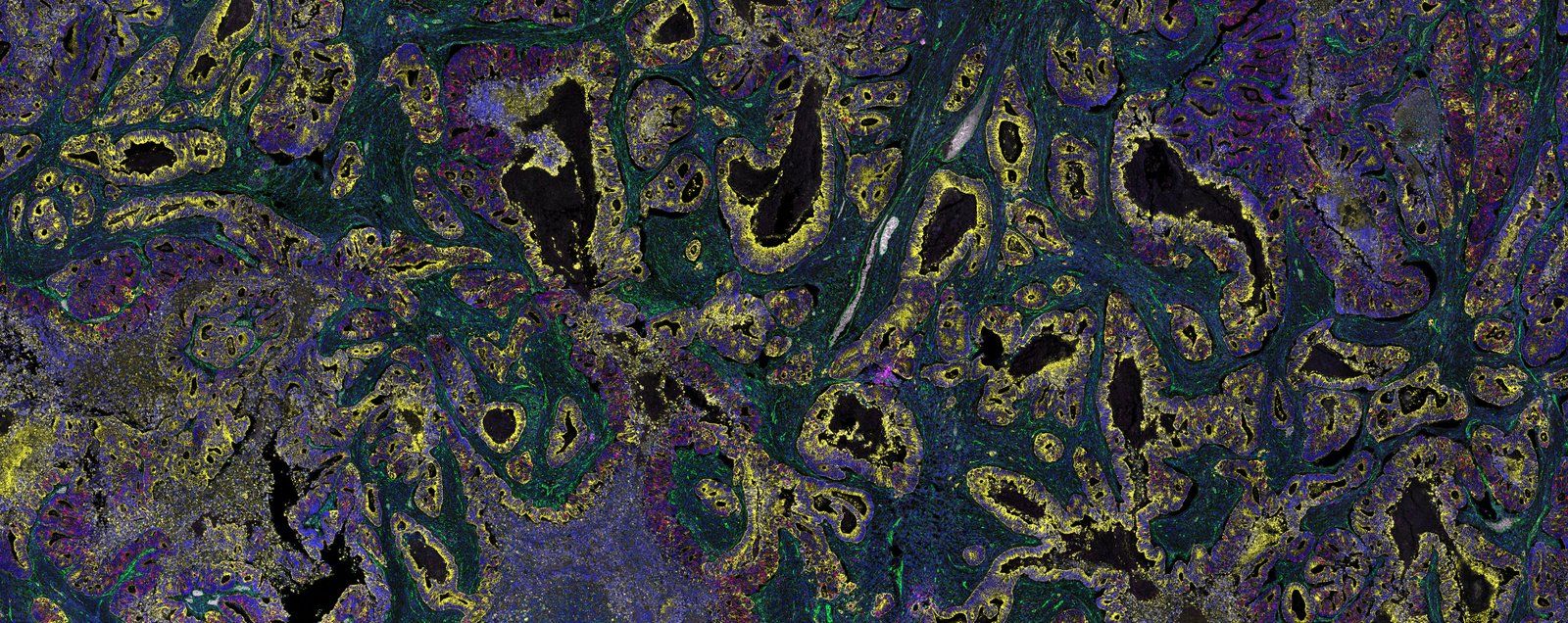
- A 13-plex immuno-oncology panel imaged on single FFPE slides mapped the post-treatment immune shift in place. CD3+ T-cell infiltration expanded where the tumor had regressed and was sparser where it had not, with CD4+ helper T cells the predominant T-cell type.
- Reading single cells in spatial context resolved differences within one resection. CD8+ cytotoxic T cells were denser in a zone of regression than in adjacent residual tumor, and a Crohn’s-like reaction drew numerous CD20+ B cells into the deeper tissue around the tumor.
- The spatial maps also captured directional detail a bulk assay — one that averages signal across the whole sample without spatial location — would miss. Regulatory T-cell density rose overall, yet the ratio of regulatory T cells to CD4+ helper T cells fell in regressing tissue and rose where tumor persisted, while proliferating immune cells were most abundant in the non-regressing areas.
Orion in the methods
“RareCyte Inc. (Seattle WA), performed a 13-marker immune-oncology panel that was developed by the company to test the pre- and post-treatment colon and rectal cancer samples on a single paraffin-embedded slide simultaneously at 20X using the Orion instrument”
— Kasi et al., Oncogene (2023), Methods, “Methods”